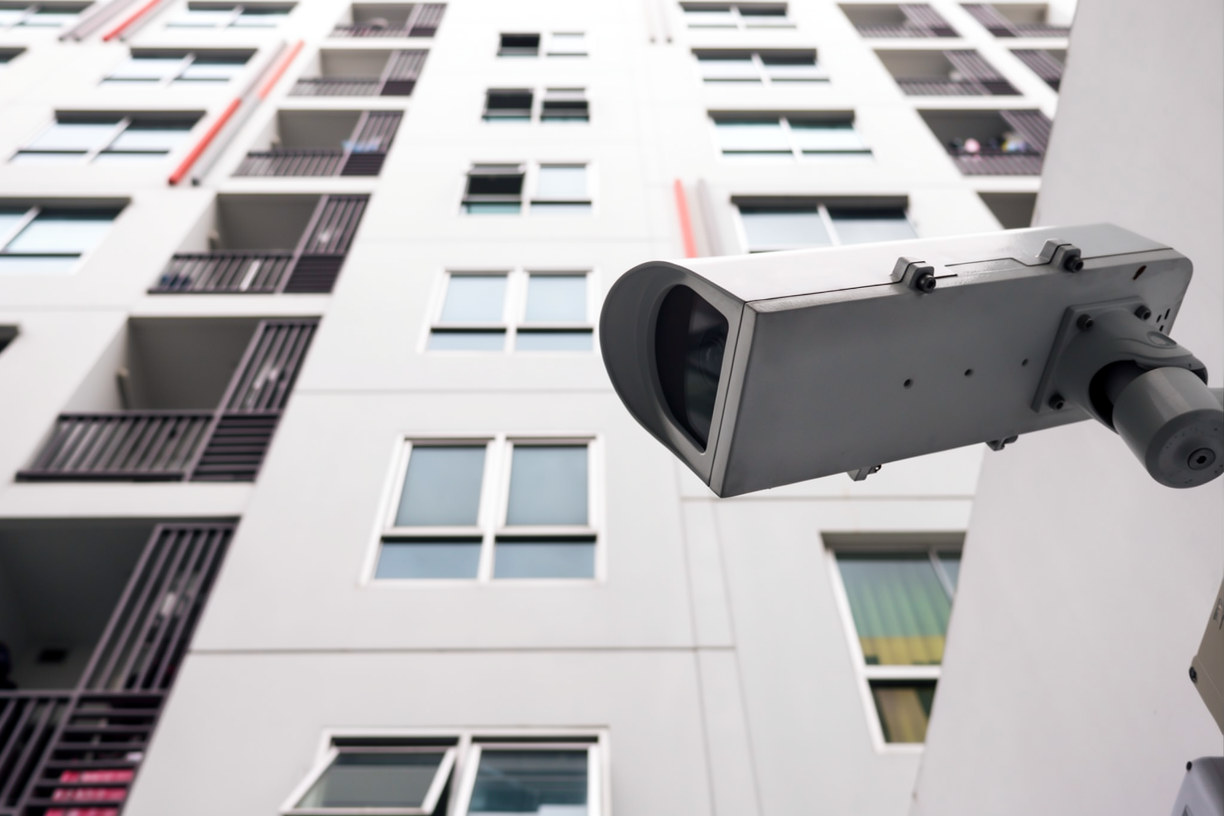
Install CCTV Outside Condominium Units in Singapore: What MCST Rules Allow
By Techcom Engineering Pte. Ltd.
Published: October 8, 2026 at 10:10 AM
If you want to learn more about installing a system at your property, you can check out the options on our main cctv camera page.
If you want to install CCTV outside condominium units in Singapore, the answer is rarely a flat yes or no. It depends on several highly specific technical and legal factors, such as where the camera is mounted, what type of surface it is attached to, how its power and data cables run, and exactly what area the camera lens records.
The space just outside your front door is usually not your personal property. In almost all strata-titled developments across Singapore, the exterior corridors, stairwells, and outer walls are classified as common property managed by the development’s Management Corporation Strata Title (MCST). Because of this shared ownership structure, any resident looking to install CCTV outside condominium doorways must navigate both estate-specific bylaws and national privacy frameworks.
This comprehensive guide is designed for condo owners, residents, MCST council members, and managing agents alike. It breaks down the exact regulatory guidelines that apply to home surveillance, outlines when you must formally ask for management approval, explains how the Personal Data Protection Act (PDPA) fits into residential recording, and provides actionable advice on how to plan a security setup that effectively protects your home without creating friction or legal disputes with your neighbors.
Can You Install CCTV Outside Condominium Unit? The Short Answer
Sometimes, and it depends entirely on the specifics of the installation. Three core questions decide the vast majority of cases:
1. Is the camera and its cabling entirely within your strata lot boundary, or does it touch common property? (For example, mounting a wire-free device directly onto your own wooden door vs. drilling into a shared concrete hallway wall).
2. Does a statutory exception for safety equipment apply to your situation? (Whether local building regulations or fire safety codes grant specific allowances for residential security measures).
3. Does your development’s by-laws say anything specific about security cameras, external fixtures, or drilling? (Every estate has unique internal rules that govern the overall aesthetic and structural integrity of the property).
If any part of the installation process requires you to drill into, attach hardware to, or run electrical cable through a corridor wall, ceiling, or external structural wall, you must treat MCST permission as a strict prerequisite. If you want to safely and legally install CCTV outside condominium units, you must secure this permission in writing before any installation work begins. Do not assume that authorization is optional or that verbal consent from a managing agent is enough to protect you from a future removal order.
What Counts as “Outside” Your Condo Unit?
Owners often assume that the area directly outside their front door is a natural extension of their private home. However, under strata ownership laws, that is frequently not the case. Recognizing where your private boundary ends and shared space begins is essential before you attempt to install CCTV outside condominium doorways.
The Building and Construction Authority (BCA) explains that common property refers to areas that do not belong to individual units. Its examples include lift lobbies, corridors, car parks, gardens, and exterior building walls. To know exactly what you own, you must look at your strata title plan. The strata plan shows what falls inside and outside your lot boundary with precise lines.
If the exact spot where you plan to install CCTV outside condominium units (such as the door frame, the hallway ceiling, or the adjacent wall) falls outside those boundary lines, it is legally common property. This means it is under the jurisdiction of the estate’s management council, rather than the individual unit owner.
| Location |
Typically |
What to check |
| Inside your unit |
Your strata lot |
By-laws on external-facing features; your sale and purchase or tenancy terms |
| Common corridor or lift lobby |
Common property |
MCST approval for mounting, cabling and field of view |
| External wall of the building |
Common property; BCA says alterations to external features need MCST and any relevant government approval |
MCST approval, plus any other authority involved |
| Your own entrance door |
Depends on the door and development |
Strata plan, by-laws, and whether the installation changes its appearance |
This table describes the usual position. Your development’s strata title plan and by-laws are the authority for your property.
If you want to learn more about installing a system at your property, you can check out the options on our main cctv camera page.
What Singapore’s Strata Law Says About Safety Equipment
The main statute is the Building (Strata Management) Act. It was previously called the Building Maintenance and Strata Management Act, so older guides and case reports use the earlier name. The same section also has had different numbering over time, so check the current text on Singapore Statutes Online.
The safety-equipment provision
In 2017, the Singapore Parliament amended the Building Maintenance and Strata Management Act to insert a brand new legal provision, originally numbered section 37A. According to the official Singapore Statutes Online database, this specific law allows a subsidiary proprietor (the legal term for an individual condominium unit owner) to install listed types of safety equipment directly on their lot, or as part of an outward-facing window, door, or opening on their lot, without first needing to secure formal MCST approval. The statute explicitly includes an intruder alarm or monitoring system as well as security locks within its approved list of equipment.
However, the specific conditions attached to this provision matter immensely:
• Property Repair Obligations: The unit owner must fully repair any physical damage caused to the common property or limited common property by the installation process.
• Competent Workmanship: The safety equipment must be installed in a competent, proper, and professional manner.
• Aesthetic Uniformity: The appearance of the equipment after it has been fully set up must remain completely in keeping with the overall appearance of the building.
There are two critical legal limits here that are very easy to miss. First, the provision covers only the exact types of equipment it explicitly lists. Singapore’s Strata Titles Boards have historically treated these statutory lists very strictly, applying a narrow interpretation in past cases involving balcony awnings. Second, it remains highly legally ambiguous whether a corridor-facing security camera mounted on a shared hallway wall actually falls within this statutory right. Because this is a nuanced legal question that completely turns on the specific physical facts of your property, you should never rely on this provision alone to justify drilling into common property to install CCTV outside condominium doorways.
The by-law on marking and fixing to common property
The Second Schedule to the Building Maintenance (Strata Management) Regulations contains a foundational, statutory by-law that explicitly stops a unit owner from driving nails, screws, or heavy anchors into any common property structures without first obtaining the MCST’s formal written approval. However, this exact same piece of legislation contains an important statutory exception. It specifically allows individual owners to install a locking device or other safety device to fundamentally improve security and prevent unauthorized entry within their own private strata lot
Singapore’s Strata Titles Boards have historically applied that safety device exception to resolve a variety of common property disputes, most notably in legal cases involving the installation of safety-related balcony awnings. Despite these precedents, it has not been definitively settled in the legal sources and case logs reviewed whether this locking and safety device exception comfortably extends to a digital monitoring camera that actively records a shared corridor. Because a hallway camera captures video footage of public areas beyond your private boundary, you should not assume this specific exception grants you automatic permission to install CCTV outside condominium doorways without formal management authorization.
What this means in practice
Statutory exceptions exist, but they are narrow, they come with conditions, and their application to a particular corridor camera is uncertain. An MCST that objects may be right or wrong. The safest course is to ask first, in writing, and to design the installation so it raises as few questions as possible.
When Is MCST Approval Likely Needed?
This matrix summarises how the issues usually play out. It is general guidance, not legal advice.
| Situation |
Common-property issue? |
Likely approach |
| Camera inside your unit, not mounted on the door or external wall |
Generally no |
Check by-laws on external-facing features; mind field of view |
| Camera or viewer built into your own door |
Possibly, depending on the door and by-laws |
Check by-laws; consider the safety-equipment provision and its conditions |
| Camera screwed or drilled into a corridor wall or ceiling |
Yes |
Ask the MCST in writing before any work |
| Cable running along or through common trunking, ducts or walls |
Yes |
Ask for approved routing |
| Camera on an external wall or window frame |
Yes; BCA says external-feature alterations need MCST and any relevant government approval |
Ask the MCST; check with relevant authorities if applicable |
| Camera that records the corridor widely |
Not an approval question alone; also a privacy and by-law question |
Narrow the view or use masking |
How to Ask Your MCST Before You Install CCTV Outside Your Condominium Unit
A clear, well-documented request is the single most useful thing you can do to ensure your security project moves forward smoothly. Preparing a structured application package significantly speeds up the MCST management committee’s decisions, as it immediately answers the typical technical questions they are legally required to ask. Furthermore, maintaining a written copy of your request and their subsequent approval protects you later from any sudden policy shifts, new committee members, or complaints from incoming neighbors. If you take the time to formalize your proposal before you attempt to install CCTV outside condominium doorways, you establish an undisputed paper trail that proves you acted with total transparency and compliance from day one.
| Step |
Action |
Output |
| 1 |
Get the by-laws from the MCST or managing agent |
A copy of current by-laws |
| 2 |
Decide the exact location, mounting method and cable route |
A short written plan |
| 3 |
Send the MCST a request with photos and specifications |
Written submission |
| 4 |
Ask for the decision and any conditions in writing |
Approval, conditions, or reasons for refusal |
| 5 |
Keep the reply before any work begins |
A paper trail |
What to Include in Your Formal Submission
When preparing your written application, providing exhaustive details leaves no room for ambiguity or hesitation from your management council. To give your application the highest chance of quick approval, make sure to include the following comprehensive details in your request:
• Hardware Visuals and Dimensions: A clear photo of the proposed physical installation location alongside the exact camera model, including its official dimensions and aesthetic color.
• Mounting Methodology: The specific mounting method you plan to use, explicitly stating whether drilling into shared masonry is required or if you are using non-destructive heavy-duty adhesives.
• Cable Infrastructure: A precise blueprint or description of how the power and data cables will be routed, confirming they will not hang loosely or create a tripping hazard in the corridor.
• Field of View and Privacy Plan: A clear description of exactly what area the camera lens will cover, along with an explanation of how you will limit the field of view (such as using digital privacy masks) to avoid filming common walkways or your neighbors’ front doors.
• Data Storage Protocols: A clear explanation of whether the recorded footage will be stored locally on an encrypted secure drive inside your home or uploaded to a password-protected cloud server.
What If the MCST Says No?
Do not install the camera anyway. Ask the MCST to explain its reasoning and to identify the by-law or guideline it relies on.
BCA explains that concerns about the validity or appropriateness of by-laws can be raised at the next general meeting or by applying to the Strata Titles Boards. Owners may also seek mediation through the Community Mediation Centre or the Singapore Mediation Centre. BCA notes that government agencies are generally not empowered to compel action in these private disputes.
If the dispute becomes serious, get legal advice. A lawyer can assess whether the by-laws apply as the MCST says, and whether a statutory exception is relevant.
Privacy and PDPA: Who Is Responsible for the Footage?
CCTV footage showing identifiable people is personal data. Whether the Personal Data Protection Act (PDPA) imposes duties on you depends on who you are.
If you are an individual homeowner
The PDPC’s Advisory Guidelines explain that the PDPA does not apply to individuals acting in a personal or domestic capacity. The PDPA defines “domestic” as related to home or family. Home security often fits that description.
Two cautions apply. First, whether a camera that records shared corridors still counts as personal or domestic use is fact-specific, and I did not find a PDPC ruling on that point. Second, being outside the PDPA does not make a camera acceptable to the MCST or your neighbours. By-laws and neighbour disputes are separate questions.
If you represent an MCST or managing agent
An MCST is an “organisation” under the PDPA. The PDPC has published Advisory Guidelines for Management Corporations that address MCSTs’ use of CCTV, including notices, access requests, protection and retention of footage.
A published PDPC undertaking involving a condominium’s perimeter camera shows how this plays out. The MCST had no data protection policy at the time. The complainant could not be identified from the footage, so the access obligation did not arise. The PDPC still accepted an undertaking requiring the MCST to improve its practices, including training the managing agent, which acts as its data intermediary.
If you want to learn more about installing a system at your property, you can check out the options on our main cctv camera page.
Designing the Camera View: Field of View and Privacy
A narrower view is easier to justify and easier to defend.
Start with the problem you are trying to solve. If it is parcels going missing or suspicious activity at your door, you may only need to cover your entrance and a short approach. You do not need the whole corridor, the lift lobby, or your neighbour’s doorway.
Practical design points:
• Angle the camera toward your own door rather than along the corridor.
• Choose a lens and mounting height that frame the area you need and no more.
• Use privacy masking if the camera supports it, to blank out neighbouring doors or windows.
• Leave audio off unless you have a specific reason, since audio raises additional privacy concerns.
• Never point a camera into a neighbour’s window or through a doorway.
These are recommendations and good practice, not statutory requirements.
Setups That Raise Fewer Approval Questions
Different setups raise different questions. None removes the need to check your by-laws.
| Option |
Touches common property? |
Considerations |
| Camera inside the unit looking through your own door area |
Usually not |
Check by-laws; field of view still matters |
| Camera or viewer integrated into your own door |
Possibly |
Door status and appearance rules; installation conditions |
| Wired camera on a corridor wall |
Yes |
Drilling, cable route, appearance; ask the MCST |
| Wireless camera on a corridor wall |
Yes (mounting) |
Mounting is still an attachment to common property |
| Request MCST common-area CCTV |
MCST decision |
Slower, but resolves corridor coverage for all residents |
Asking the MCST council to consider common-area coverage is a legitimate route if corridor safety is your real concern. Whether it succeeds is up to the MCST.
Storing and Protecting Footage
Footage is only useful if it is kept securely and for a sensible period.
• Storage: Decide whether footage stays on a local recorder or goes to a cloud service. Each affects who can access it.
• Access: Use strong, unique passwords and avoid sharing logins.
• Retention: Keep footage only as long as you need it. Organizations covered by the PDPA are subject to a retention limitation obligation; individuals should apply the same discipline.
• Disclosure: Do not post footage of neighbors online. Share it with the MCST or police when there is a real security reason.
Choosing an Installer for a Condo
A good installer will ask about your by-laws before they ask about camera models.
Questions to put to any contractor:
• Will you work from the MCST’s written approval and conditions?
• How will you route cables, and how will you make good any damage to common property?
• Can the camera’s view be limited, and can it be masked?
• Where will recordings be stored, and who can access them?
The Ministry of Communications and Information stated in 2019 that anyone providing CCTV installation or maintenance as a service needs a Security Service Provider licence under the Private Security Industry Act. Confirm current requirements with the Police Licensing and Regulatory Department, and ask to see a contractor’s licence.
If you want help planning placement, cabling and storage for a Singapore condo, [Internal Link: Residential and Condominium CCTV Installation Services] is a sensible place to start the conversation.
Common Mistakes to Avoid
When homeowners feel their security is compromised, they often rush into buying and mounting surveillance equipment. However, making missteps during this process can lead to costly fines, forced removal of your equipment, and strained relations with your neighbors. Be sure to avoid these frequent errors before and during your project:
• Installing First and Asking Later: Mounting a camera without prior authorization is the fastest way to get flagged by property management. You should always secure written approval before any work begins on the property.
• Assuming the Corridor Outside Your Door Is Private: The hallway right outside your main entrance is legally classified as common property. Treating this shared walkway as your own personal zone will likely breach your estate’s structural and aesthetic regulations.
• Pointing the Camera at a Neighbor’s Entrance: Aiming a lens directly at another resident’s front door or private entryway is a major violation of privacy. Your camera should be strictly angled to cover your own immediate doorstep.
• Running Exposed Cables Through Common Areas Without Approval: Leaving loose, unsightly power or data wires dangling along shared corridor walls or ceilings creates an immediate tripping hazard and a visual eyesore that MCST councils will reject.
• Choosing a Wide-Angle Camera When a Narrow View Would Do: Purchasing a fish-eye or wide-angle lens often captures unnecessary footage of the entire floor. Opting for a camera with a narrow field of view helps you focus purely on your entryway while respecting public boundaries.
• Treating the Safety-Equipment Provision as Automatic Permission for Any Camera Anywhere: Misinterpreting local laws to mean you have a blanket right to mount hardware wherever you please is a major legal risk. The safety provision has strict limitations, and it never gives you automatic permission to install CCTV outside condominium units on shared walls without checking building guidelines first.
Final Checklist: Before You Install CCTV Outside Your Condominium
To ensure your home security project is entirely legal, safe, and respectful of your community, follow this structured, five-phase roadmap. Checking off these crucial steps will streamline your setup process and protect you from unexpected compliance issues.
Phase 1: Planning
• Identify Private vs. Common Boundaries: Carefully determine whether your desired camera location falls completely inside your private strata lot or if it sits on shared common property.
• Document the Security Problem: Clearly write down the specific security vulnerability or problem you are trying to solve, as having a clear justification helps when presenting your case to management.
• Minimize the Surveillance Zone: Decide on the absolute smallest physical area you actually need to cover to protect your doorway, avoiding expansive views of shared spaces.
Phase 2: Preparation
• Review Estate Management Rules: Obtain and thoroughly read through your specific MCST or HOA by-laws to understand the exact regulations governing external additions.
• Compile Technical Specifications: Prepare clear photos of the site, detailed camera hardware specifications, your intended mounting method, and a precise map of the cable route.
• Secure Landlord Consent If Renting: If you are a tenant renting the unit, check your tenancy agreement and make sure to secure your landlord’s formal consent before approaching property management.
Phase 3: Approval
• Submit a Written Request: Send a comprehensive, formalized written request containing your installation plan directly to the MCST board or the managing agent.
• Retain Official Documentation: Keep a safe digital and physical copy of the written decision alongside any specific conditions or restrictions imposed by the council.
• Request Clear Justification If Denied: If your request is refused, politely ask the management team for the exact by-law or clause they relied on so you can evaluate your next legal steps or adjustments.
Phase 4: Installation
• Hire a Compliant Contractor: Use a professional security installer or contractor who explicitly agrees to follow all of the conditions set forth by the MCST.
• Verify Professional Credentials: Confirm that the contractor holds valid licensing with the Police Licensing and Regulatory Department (PLRD) to ensure a fully legal, professional setup.
• Remediate Any Structural Impacts: Promptly repair any accidental physical damage caused to the common property walls or ceilings during the mounting process.
Phase 5: After Installation
• Fine-Tune the Lens Angle: Double-check the live field of view immediately after mounting and apply digital privacy masking over areas that capture neighbor walkways.
• Secure the Device Access: Set strong, unique passwords on the camera software and strictly limit access to the live feed to authorized household members only.
• Establish a Data Retention Protocol: Set a clear video retention approach (such as automatically deleting clips after 7 to 14 days) and stick to it strictly to respect local privacy frameworks.
Frequently Asked Questions
Can I install CCTV outside my condo unit without MCST approval?
This cannot be safely assumed. The requirement for approval almost always depends on whether the installation attaches to, drills into, or physically crosses over common property. While a specific statutory exception for safety equipment does exist under local regulations, it is narrow, highly conditional, and strictly interpreted. Proceeding without written authorization places you at risk of receiving an enforcement notice from management.
Does the PDPA apply to my home CCTV?
According to official advisory guidelines issued by the Personal Data Protection Commission (PDPC), the Personal Data Protection Act (PDPA) does not apply to individuals who are acting in a purely personal or domestic capacity. However, MCSTs, management bodies, and commercial organizations are fully covered by these strict regulations. Because a corridor-facing camera captures footage of individuals passing through shared communal areas, it sits in a complex legal grey area that is always worth discussing explicitly with your MCST to avoid privacy complaints.
Can my MCST make me remove a camera?
That ultimately depends on the specific wording of your estate by-laws and the physical facts of your installation. If a camera violates the rules on common property alterations, the management council has the authority to issue a removal demand. If you believe the request is unjust, concerns about by-laws can be formally raised by residents at an annual general meeting, or the dispute can be escalated and taken to the Strata Titles Boards for a formal ruling. You should seek independent legal advice if the dispute becomes serious or heads toward litigation.
I rent my unit. Can I install a camera?
If you are a tenant, you must check your tenancy agreement and speak directly to your landlord before purchasing any hardware. Even if your landlord grants you personal permission, the formal MCST approval process still applies completely if the installation touches or involves common property. Getting both the property owner and the condo management board to sign off on your plan ensures you do not inadvertently breach your lease terms or estate regulations.